
Searchlight Thinking: Why Association Leaders Need to See Broadly Before They Focus
The problem directly in front of you may not be the problem you actually need to solve.
Association leaders are surrounded by specialists.
We have experts in membership, finance, technology, advocacy, education, marketing, meetings, governance, HR and countless other disciplines. Their expertise matters. Complex organizations need people who can go deep.
But someone also has to look across all of it.
Someone has to recognize that declining membership may not actually be a membership problem. Staff burnout may not be solved by hiring more people. A dysfunctional board may not simply have a governance problem. And replacing an association management system won't fix processes that didn't work in the first place.
That requires a different kind of thinking.
I call it Searchlight Thinking™.
Searchlight intelligence versus laser intelligence
The idea has an important intellectual antecedent in the work of psychologist Howard Gardner.
Gardner has described a distinction between laser intelligence and searchlight intelligence. Laser intelligence allows someone to concentrate deeply on a particular subject. Searchlight intelligence operates differently: it scans a wider field, looking across areas of knowledge and bringing disparate information together.
Both are valuable.
A CFO needs deep financial expertise. An attorney needs deep legal expertise. A technology leader needs to understand systems at a level the CEO probably never will.
Those are powerful lasers.
But executive leadership requires something else as well.
The CEO, and often the COO, has to operate the searchlight.
They need enough understanding of finance, governance, membership, technology, programs, people, culture, strategy and the external environment to recognize how a decision in one area will affect another.
That's where Gardner's concept resonates so strongly with my own experience leading and advising associations.
The danger of Spotlight Thinking
Spotlight thinking focuses intensely on the problem that has attracted everyone's attention.
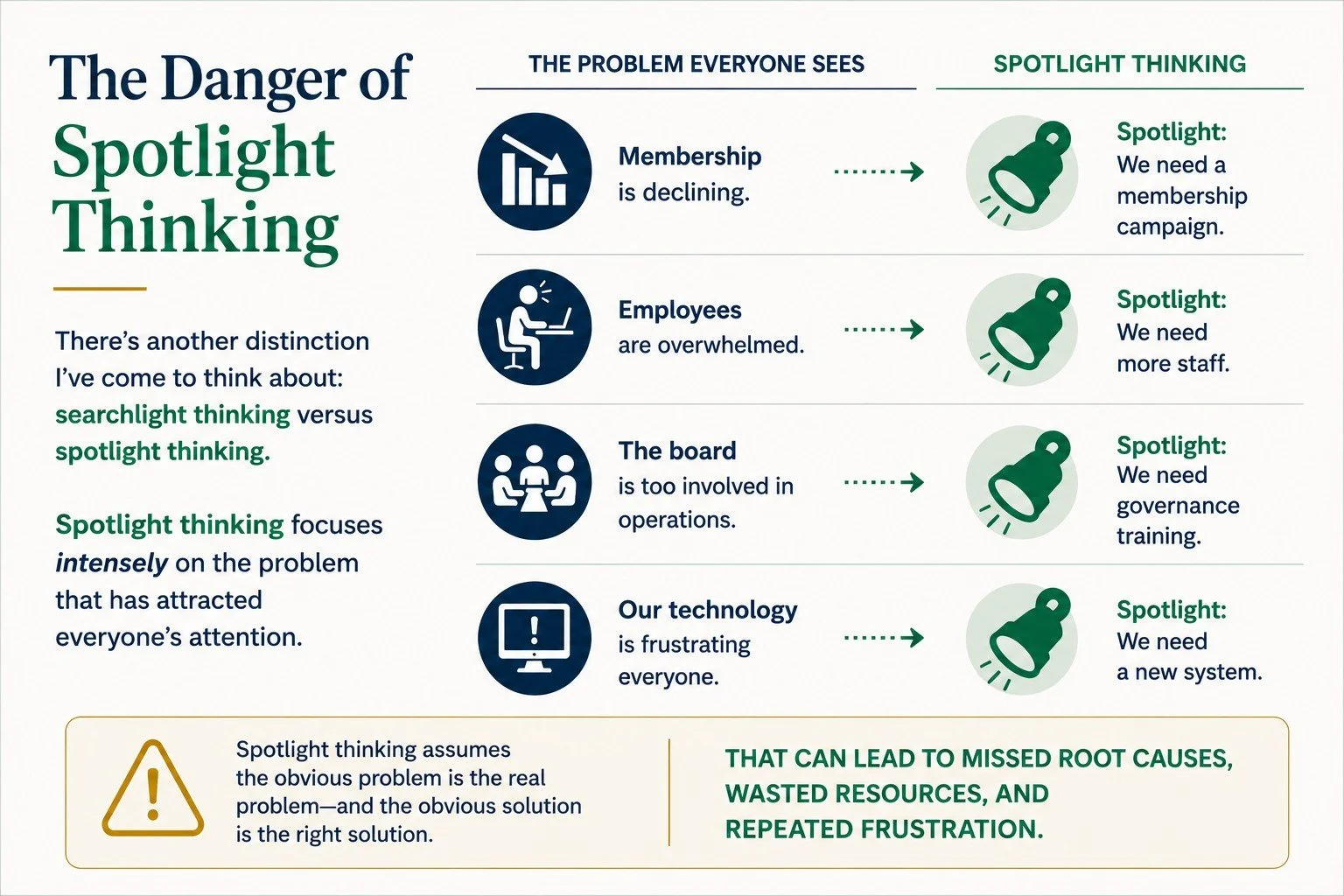
A branded infographic illustrating the danger of Spotlight Thinking—the tendency to focus narrowly on the most visible organizational problem and jump quickly to an obvious solution. Examples include responding to declining membership with a membership campaign, overwhelmed employees with more staff, board overreach with governance training, or technology frustration with a new system.
Any one of those solutions could ultimately be right. But they begin with an assumption that the visible problem and the underlying problem are the same thing. Often, they aren't.
Searchlight Thinking asks a different first question: What else do we need to see before we decide what problem we're actually solving?
I've seen this repeatedly in organizational work.
An association experiencing declining membership may discover that recruitment isn't its primary problem at all. Perhaps members don't understand the value they're already receiving. Maybe younger professionals don't see programs designed around the realities of their careers. Perhaps valuable content is available to everyone, leaving little compelling reason to pay dues. Or maybe retention, not acquisition, is where the organization is actually losing ground.
A team that appears understaffed may indeed need more people. But look more broadly and you may find overlapping responsibilities, unclear decision rights, manual processes, poor technology and work that continues simply because no one has ever asked whether it should.
A board that seems overly operational may not need another presentation on the difference between governance and management. The board may have stepped into operations because management capacity was weak, information wasn't reaching directors, or nobody trusted that important work would otherwise get done.
Those require very different solutions.
That's why I believe leaders should sweep the searchlight across the landscape before narrowing the beam.
Organizations are systems, not collections of departments
This is particularly important in associations because almost everything is interconnected.
Pull one lever and something else moves.
That's why one of the most useful questions an executive can ask after making a strategic decision is:
If we're serious about doing this, what else in the organization has to change?
If the strategic plan says the organization is going to become a leader in digital education, but the budget, staffing structure and technology investments remain unchanged, it isn't really a strategy.
If the board says it wants to become more strategic but continues receiving 150 pages of committee reports and spending meetings discussing operational details, governance hasn't actually changed.
If leadership says developing the next generation of members is a priority but the organization's programs, communications, volunteer structures and pricing remain designed around the existing generation, the priority exists on paper only.
Strategy becomes real when the organization underneath it changes.
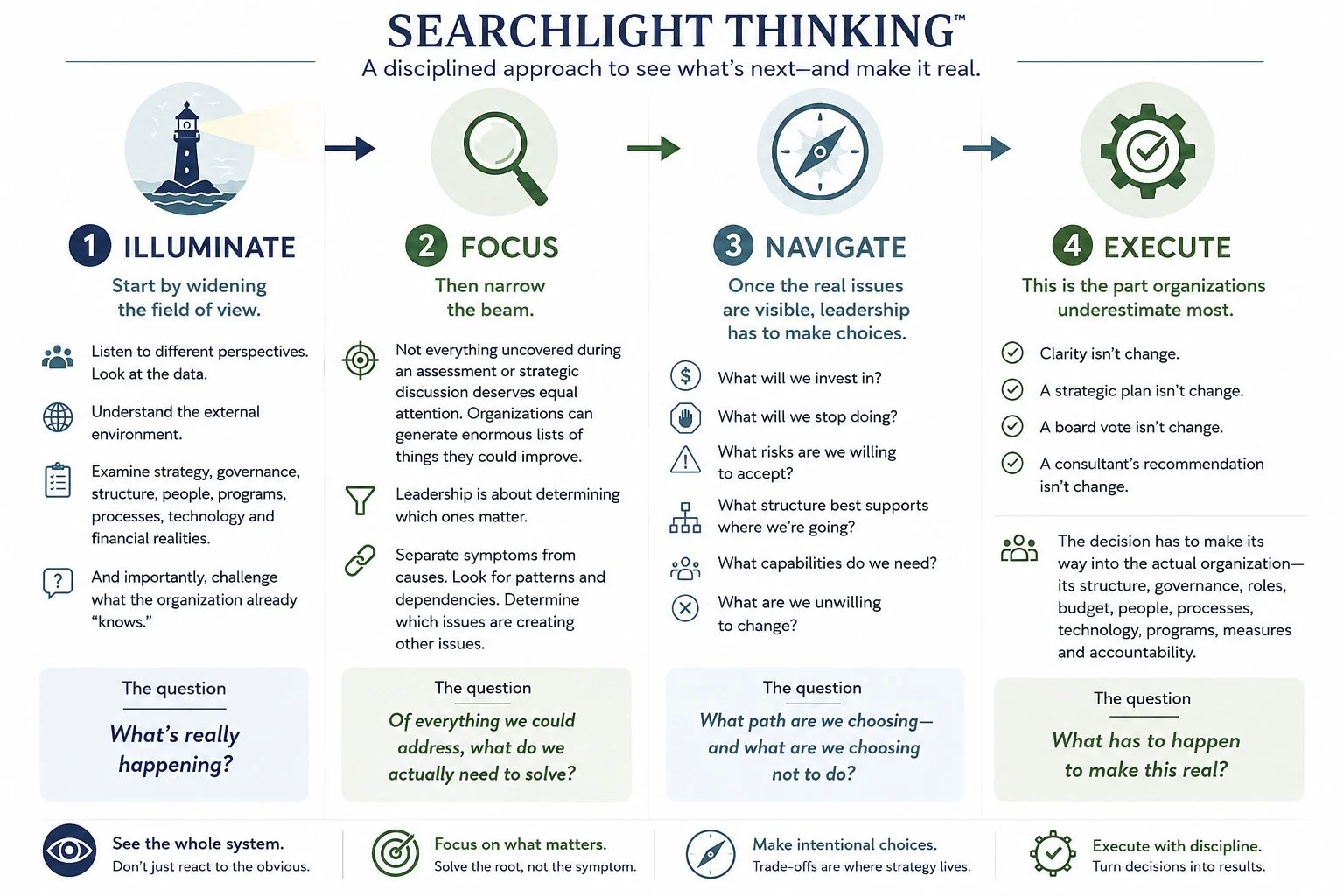
A branded infographic illustrating the four stages of Searchlight Thinking™: Illuminate, Focus, Navigate, and Execute. The framework shows how leaders first widen their field of view to understand what is really happening, then identify the issues that matter most, make intentional choices about the path forward and its trade-offs, and finally translate those decisions into action. The visual emphasizes a disciplined, whole-organization approach to moving from complexity and insight to clarity, direction, and meaningful change.
What this means for CEOs
This ability to move between the broad landscape and the narrow beam is particularly important for CEOs.
Executives need specialists around them. But the CEO can't become the deepest specialist in every function.
The CEO's distinctive responsibility is increasingly one of integration.
How does the membership strategy affect the business model?
How does the business model affect programs?
How does strategy affect organizational structure?
How does board composition affect strategy?
How will a technology decision affect the member experience?
How will a restructuring affect culture?
How does today's decision constrain tomorrow's options?
That's the searchlight.
And it can be particularly important for executives who come into association leadership from the industry or profession the association serves. Their industry expertise may be extraordinary. The leadership challenge is learning to scan a very different organizational landscape—one where members are simultaneously customers, owners and volunteers; where a board has genuine authority; and where mission, market, governance and business realities constantly intersect.
What this means for boards
Boards need Searchlight Thinking too.
One of the board's most valuable roles is to look beyond the immediate operating horizon.
Management necessarily spends enormous amounts of time focused on today's organization. Boards can help illuminate tomorrow's environment.
What's changing in the profession?
What assumptions underlying our business model may no longer be true?
What will the next generation expect from us?
Where are new competitors emerging?
What capabilities will the organization need three years from now?
What risks aren't showing up on the dashboard yet?
Those are searchlight questions.
They move governance away from reviewing what has already happened and toward helping the organization see what may be coming.
The advisor's role isn't always to have the answer
There's one more reason the searchlight metaphor matters to me.
I don't believe an effective executive advisor should walk into an organization assuming she already knows the answer.
Experience matters. Patterns matter. Frameworks matter.
But every organization has its own history, culture, politics, people, economics and ambitions.
The advisor's job isn't simply to shine a spotlight on her own expertise.
It's to help leadership see more clearly.
Sometimes that means illuminating something the organization hasn't noticed.
Sometimes it means connecting issues that have been treated separately.
Sometimes it means challenging a long-held assumption.
Sometimes it means narrowing ten priorities to three.
And sometimes leadership already knows the answer—it just needs someone to help bring it into focus and navigate what comes next.
That's the idea behind Searchlight Thinking.
Illuminate the full landscape. Focus on what matters. Navigate the critical choices. Execute the path forward.
Because when organizations are navigating complexity, seeing more clearly isn't the end of the work.
It's how better decisions begin.
Amy Williams is the founder of Searchlight Executive Advisors, advising association CEOs and boards on strategy, governance, organizational architecture and transformation. Searchlight also provides fractional and interim executive leadership for associations navigating periods of significant change.
